
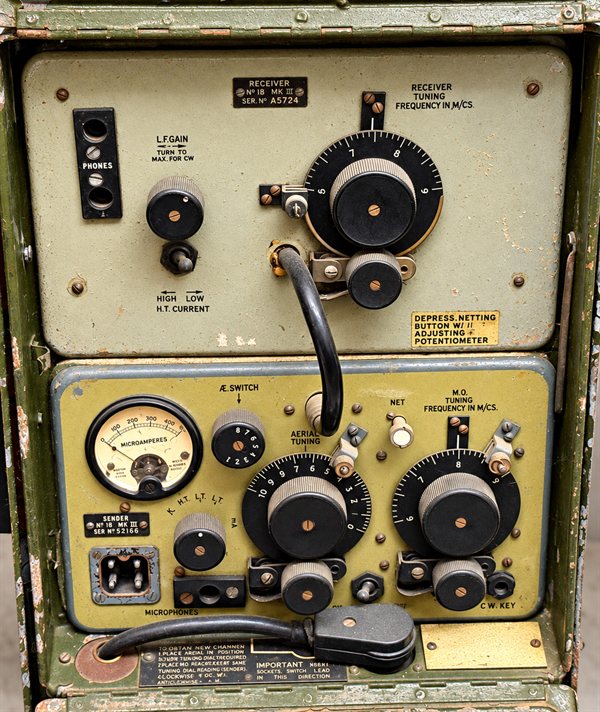
The Wireless Set No. 18 was a British Army portable radio transmitter and receiver developed shortly before the Second World War and introduced into service in 1940.
It became one of the most important British infantry radio sets of the war, providing communication between battalion headquarters and companies operating in the field.
Unlike the Wireless Set No. 19, which was primarily intended for tanks and other vehicles, the No. 18 was designed to be carried on a soldier's back.
Technical specifications:
- Introduced: 1940
- Manufacturer: Pye and other British manufacturers
- Frequency coverage: 6–9 MHz
- Wavelength: Approximately 33–50 metres
- Transmitter output: Approximately 0.25 watts
- Modulation: AM speech (R/T) and Morse (CW)
- Receiver: Valve-operated, tunable
- Frequency control: Master oscillator
- Power supply: Combined dry batteries
- Operating range: Typically a few miles, up to about 10 miles under favourable conditions
- Construction: Pressed-steel case with carrying harness
Wireless Set No. 18:
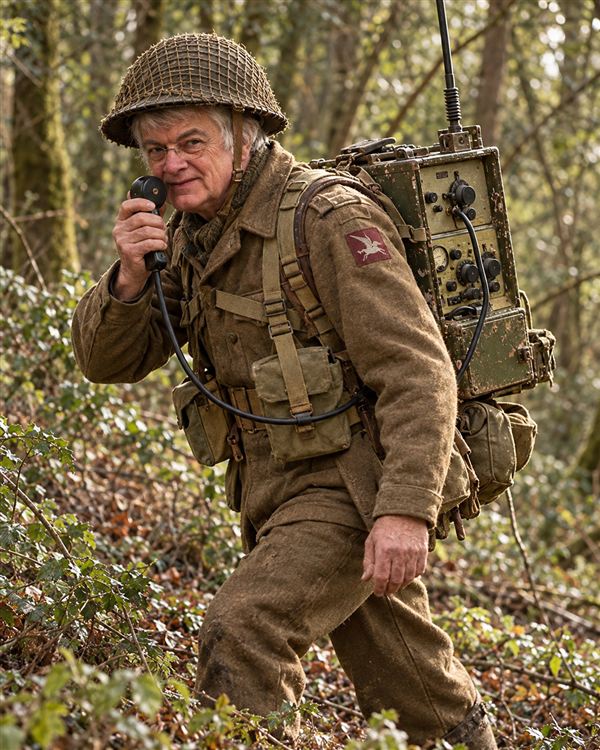 The No. 18 originated from work on an earlier military radio known as the Wireless Set No. 8. The original equipment was considered too heavy and cumbersome for infantry use. Pye redesigned the construction, introducing a lightweight ribbed metal case while retaining the essential radio circuitry. In 1939, prototypes were sent to France for field trials. The design proved successful, and production began in 1940. Approximately 76,000 Wireless Set No. 18 units were eventually manufactured.
One of the first transceivers I owned was a WS No 18 set. I hooked it up to a homebrew power supply and an aerial and it worked! I was 16 at the time and didn’t have a license but, when I heard a chap calling CQ on 40 metres, I had to reply. Using a made-up call sign, I gave him a shout and he heard me! He was in Southampton, which was about 40 miles from my home QTH. Crikey, I couldn’t believe it! It wasn’t long before I bought my first WS No 19 set. A far superior radio to the 18 set.
I was more than a little surprised to make a contact over that distance with 2.5 Watts and an end-fed wire aerial.
Aerials and power
The set could use aerial rods which, along with other accessories, were carried in a canvas haversack. It normally ran from a combined dry-cell pack called a battle battery, fitted inside the case. For longer use, Power Supply Unit No. 5 provided the required voltages from a rechargeable accumulator, with a hand-cranked generator used to keep it charged while operating.
The No. 18 and No. 38 filled different infantry roles. The No. 18 covered 6-9 MHz and was intended for communication between company and battalion headquarters. The No. 38 covered roughly 7.3-9 MHz, had similar low transmitter power, and was a smaller, simpler set used for shorter-range links. Its range is often given as around four miles, though actual performance depended on aerials and conditions.