Crystal sets were extremely popular in Britain during the first half of the 1920s. Their biggest attraction was that they didn’t need batteries or a mains supply. A crystal set normally consisted of a tuning coil, variable condenser, crystal detector and a pair of high-impedance headphones so they weren’t too expensive and, for those interested in radio, they were easily constructed.
The detector was a piece of galena crystal and a fine wire called a cat's whisker. By carefully adjusting the wire on the crystal, a sensitive spot could be found where a station could be heard. Over the years, I’ve built several crystal sets and they can be tricky to set up. However, once tuned in to a station, they work well.
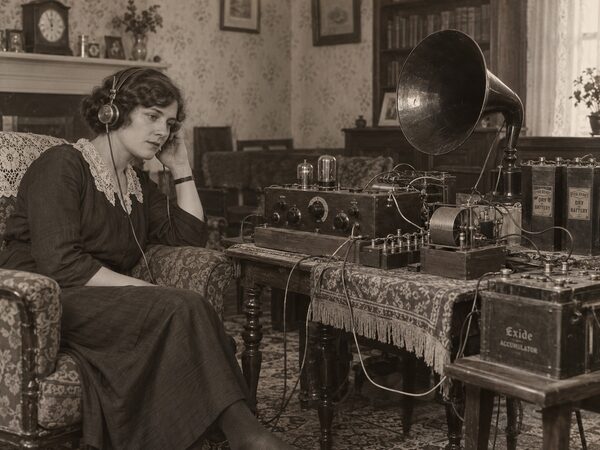 A long outdoor aerial was important because the receiver obtained all its power from the incoming radio signal. The sound was too weak to operate a loudspeaker so, listening through headphones was normal. I’m not sure whether more than one pair of headphones could be used. There might not have been enough power to drive two pairs.
Valves amplified weak radio signals so listeners could receive more distant stations and, with sufficient amplification, a loudspeaker could be used. This allowed the whole family to listen to the radio rather than just one person at a time.
Early British valve radios often featured polished mahogany cabinets, black ebonite control panels, large tuning knobs and exposed plug-in coils. Many were tuned radio frequency (TRF) receivers, while some employed reaction, or positive feedback, to increase sensitivity.
A typical early three-valve receiver might have:
- One high-frequency amplifying valve.
- One detector valve, sometimes using reaction.
- One low-frequency amplifying valve to drive headphones or a horn loudspeaker.
Reaction was particularly useful for increasing sensitivity and selectivity. However, excessive reaction could cause the receiver to oscillate and radiate interference into neighbouring sets.
In 1922, domestic mains electricity was not universally available, so battery operation was the normal arrangement for many early receivers.
| Supply | Typical voltage | Purpose |
|---|---|---|
| LT (low tension) | 2, 4 or 6 volts | Heating valve filaments |
| HT (high tension) | 45–120 volts | Supplying valve anodes |
| GB (grid bias) | 1.5–9 volts or more | Providing negative grid bias |
The LT supply was from a rechargeable lead-acid accumulator. Early bright-emitter valves often required relatively high filament currents, making accumulator capacity particularly important.
The HT supply came from dry cells connected in series. Unlike the LT accumulator, the HT battery was normally replaced when flat. Some grid-bias batteries had several tapping points so that different negative bias voltages could be selected. The correct voltage was important for the valves to operate correctly.
Eric Kirkham Cole. Ekco.
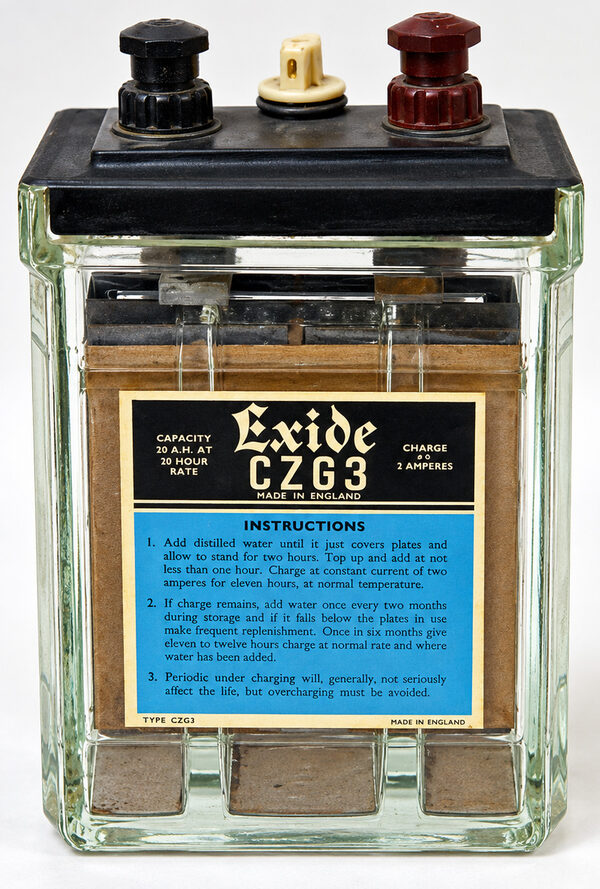 Early radios used dry cell batteries for the HT and grid bias supplies. The valve heaters were powered by a 2-volt accumulator, which needed charging regularly. These could be taken to a local garage or electrical shop to be charged for a nominal sum.
Eric Cole’s first arrangement used the local 230-volt DC supply, with electric lamps acting as dropping resistances to provide 2 volts for the valve filaments. Earlier sets used various filament voltages, sometimes with a rheostat dropping the excess voltage from an accumulator. A large capacitor across the DC supply helped suppress hum. The radio still needed its HT battery until Eric Cole developed the arrangement further.
Commercial DC models followed. A February 1928 Wireless World review describes an Ekco DC eliminator for receivers with up to five valves. These units adapted and filtered the existing DC supply rather than converting AC into DC.
AC versions were available later, using rectification to supply the DC needed by a battery radio. AC mains electricity was available in Britain as early as 1881, but it took decades to spread throughout the country.
Godalming in Surrey began a public electricity supply in September 1881, using a waterwheel-driven Siemens alternator to supply street lighting and private customers. Local electricity companies developed separate systems, so AC and DC supplies existed alongside one another. Even as late as 1937, about 87% of electricity consumers had AC, with the remaining 13% still on DC.
Radios in the 1920s were very different from the familiar wooden-cabinet valve receivers of the 1930s. Many were simple crystal sets, while more expensive receivers used just one, two or three valves. Most required an external aerial and a good earth connection, and many were powered entirely by batteries.
The BBC
One of the most important dates in British broadcasting history was 14 November 1922, when the newly formed British Broadcasting Company began its daily service from London station 2LO.
The Company was formed by wireless manufacturers, including Marconi, with the intention of providing regular broadcasts that would encourage the public to purchase wireless receivers. Other early stations included Manchester's 2ZY, Birmingham's 5IT and Newcastle's 5NO.
The early programmes included news, music, talks and entertainment. A broadcasting receiving licence cost ten shillings a year. In the early 1920s, wireless was as much a practical hobby as a form of entertainment.
Many listeners preferred to construct their own receivers rather than purchase ready-made equipment. Wireless magazines published circuits, construction details and advertisements for components. A typical constructor might purchase a wooden cabinet, an ebonite panel, valve holders, tuning condensers, coils, terminals and the necessary wiring. A one-valve regenerative receiver was a particularly attractive project because it could provide impressive reception with comparatively few components. Experiments included trying different aerial lengths, changing reaction coupling and adding low-frequency amplifier stages.
Although we often associate the 1920s with large, expensive valve receivers, the crystal set remained enormously important. For many families, their first experience of wireless was listening through headphones to a simple crystal receiver connected to a wire aerial in the garden. It is remarkable that such a receiver could reproduce speech and music without any local electrical power supply.
I’m working on this page.